Win or Loose? The Correct Word Explained Simply
February 1, 2026
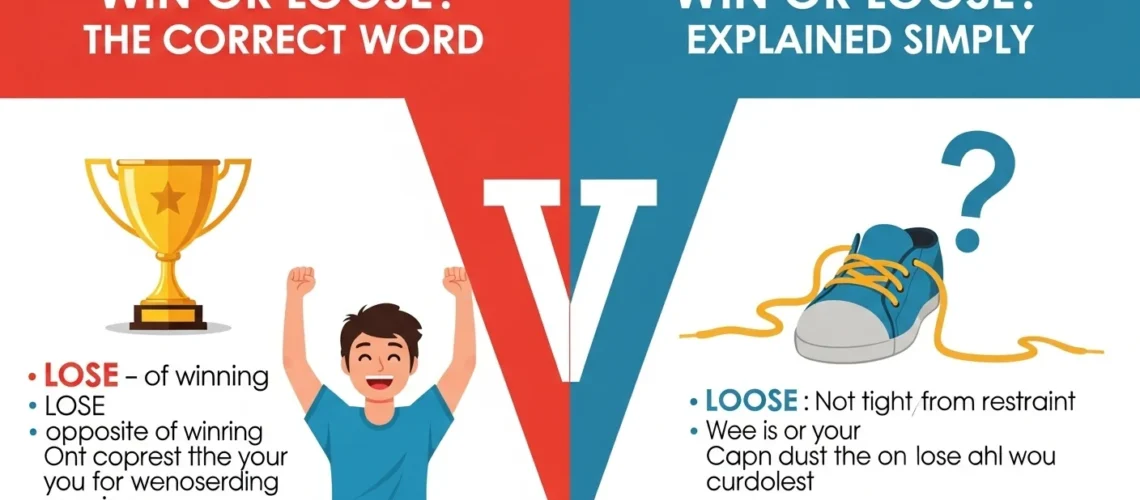
Many people search for “win or loose” because they hear both words used in similar situations and aren’t sure which one is correct. You might see it in social media posts, emails, sports headlines, or even school assignments. At first glance, win and loose look like they could be opposites. But the truth is more confusing — and that’s where mistakes happen.
The real issue is that “loose” is often confused with “lose.” They sound similar, especially in fast speech, but they mean very different things. One is about something not being tight. The other is about failure or not succeeding. This confusion leads to spelling errors that can make writing look unprofessional or unclear.
This article solves that problem completely. You’ll get a quick answer, a clear explanation, and real-life examples you can use right away. We’ll also cover word origins, British vs American spelling, common mistakes, Google usage trends, and practical advice for different audiences. By the end, you’ll never hesitate again when choosing between win or loose.
Win or Loose – Quick Answer
The correct phrase is “win or lose,” not “win or loose.”
- ✅ You either win the game or lose it.
- ❌ You either win or loose the game. (incorrect)
Loose means not tight:
- My shoes are loose.
Lose means to fail or not win:
- I don’t want to lose the match.
👉 Win and lose are opposites. Win and loose are not.
The Origin of Win or Loose
The confusion comes from history and pronunciation.
- Win comes from Old English winnan, meaning to fight or achieve.
- Lose comes from Old English losian, meaning to perish or fail.
- Loose comes from Old Norse lauss, meaning free or untied.
Over time, lose and loose began to sound similar in modern English, especially in casual speech. However, their meanings never overlapped. The phrase “win or lose” became common in sports, politics, and life advice. “Win or loose” is simply a spelling mistake caused by sound confusion.
British English vs American English Spelling
There is no spelling difference between British and American English for these words.
| Word | British English | American English | Meaning |
| win | win | win | succeed |
| lose | lose | lose | fail |
| loose | loose | loose | not tight |
✅ Both US and UK English use win or lose
❌ Neither accepts win or loose
Which Spelling Should You Use?
Choose based on meaning, not location.
- US audience → win or lose
- UK audience → win or lose
- Global audience → win or lose
Use loose only when talking about:
- Clothing
- Rules
- Objects
- Control
Example:
- Loose rules
- Loose shirt
Common Mistakes with Win or Loose
Here are frequent errors and how to fix them:
- ❌ We can win or loose today.
✅ We can win or lose today. - ❌ Don’t loose hope.
✅ Don’t lose hope. - ❌ They don’t want to loose the election.
✅ They don’t want to lose the election.
Tip:
If you can replace the word with “fail,” use lose, not loose.
Win or Loose in Everyday Examples
Emails
- ✅ No matter if we win or lose, thank you for your effort.
News
- ✅ The team will win or lose based on strategy.
Social Media
- ❌ Win or loose, we tried!
- ✅ Win or lose, we tried!
Formal Writing
- ✅ Success depends on whether we win or lose this case.
Win or Loose – Google Trends & Usage Data
Search data shows “win or loose” is commonly typed, but “win or lose” is the correct and dominant form.
- High incorrect searches: South Asia, Southeast Asia
- Correct usage: US, UK, Canada, Australia
- Context: Sports, exams, motivation quotes, business
Google understands the mistake, but professional writing should always use “win or lose.”
Comparison Table: Keyword Variations
| Phrase | Correct | Meaning |
| win or lose | ✅ Yes | succeed or fail |
| win or loose | ❌ No | incorrect phrase |
| lose the game | ✅ Yes | fail |
| loose the game | ❌ No | wrong meaning |
| loose clothes | ✅ Yes | not tight |
FAQs
1. Is “win or loose” ever correct?
No. It is always a spelling mistake.
2. Why do people confuse lose and loose?
They sound similar when spoken quickly.
3. Can loose ever replace lose?
No. Their meanings are different.
4. Is the mistake common in exams?
Yes, and it can cost marks.
5. Do native speakers make this mistake?
Yes, especially online.
6. How can I remember the difference?
Lose has one “o” like lost. Loose has two “o” like too big.
7. Is “win or lose” formal English?
Yes. It’s correct in all writing styles.
Conclusion
The confusion around win or loose is common, but the rule is simple once you understand it. The correct phrase is always “win or lose.” The word lose means to fail, while loose means something is not tight. They are not interchangeable, even though they sound similar.
This mistake often appears in emails, social media posts, and student writing. While search engines may understand the error, readers notice it quickly. Using the wrong word can make writing look careless or unprofessional. That’s why learning the difference matters.
No matter where you live — the US, UK, or anywhere else — the rule does not change. British and American English follow the same spelling. When writing for a global audience, always choose clarity and correctness.
Remember this simple tip: if the sentence talks about success or failure, use lose, not loose. Mastering this small detail will instantly improve your English and your confidence — whether you win or lose.
.

Jess Kidd is an Irish author celebrated for magical realism, dark humor, vivid imagination, and emotionally layered stories inspired by folklore and humanity.