Momma or Mama – Which One Is Correct? Meaning, Differences, and Proper Usage
January 30, 2026
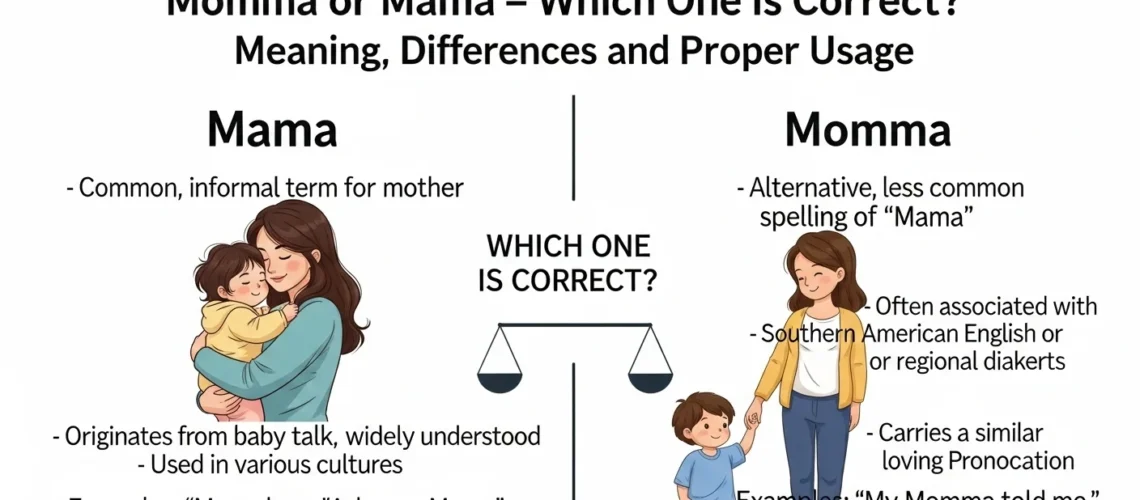
Have you ever stopped while texting or writing and wondered: Is it momma or mama? You’re not alone. This is a very common question, especially for parents, writers, students, and anyone posting online. Both words look similar, sound similar, and refer to the same person — a mother. So why is there confusion?
People search for “momma or mama” because the two spellings are used in different ways, places, and situations. One often feels warmer and more emotional, while the other feels simpler and more universal. Songs, movies, baby talk, and social media make things even more confusing by using both spellings freely.
This article clears up that confusion once and for all. You’ll learn the exact meaning of each word, where they come from, how British and American English treat them, and which spelling you should use based on your audience. You’ll also see real-life examples, common mistakes, and usage trends. By the end, you’ll know exactly when to use momma and when mama — with confidence.
Momma or Mama – Quick Answer
Both “momma” and “mama” are correct, but they are used differently.
- Mama is the standard and widely accepted spelling for “mother.”
- Momma is a more informal, emotional, or affectionate version.
Examples:
- Mama is cooking dinner.
- I miss you, Momma.
In formal or general writing, mama is the safer choice.
The Origin of Momma or Mama
The word mama comes from very early child language. Babies across many cultures naturally make sounds like ma, pa, and ba. Over time, mama became a common word for “mother” in many languages.
Momma developed later as a spelling variation, mainly in English-speaking countries. It reflects pronunciation and emotion rather than formal rules. Writers often use momma to show warmth, closeness, or dialect.
Why the difference exists:
- Mama = traditional, universal form
- Momma = emotional, informal variation
Both evolved naturally through speech, not strict grammar rules.
British English vs American English Spelling
There is no strict British vs American spelling rule for momma or mama, but usage patterns differ.
| Aspect | American English | British English |
| Common spelling | Mama | Mama |
| Informal usage | Momma (popular) | Mum / Mummy |
| Formal writing | Mama | Mama |
| Emotional tone | Momma | Rare |
Key point:
- Mama works in both US and UK English.
- Momma is mostly American and informal.
Which Spelling Should You Use?
Choose based on your audience and purpose:
- United States:
Use mama for general writing. Use momma for emotional or personal tone. - UK & Commonwealth (UK, Australia, Canada):
Use mama or local terms like mum. Avoid momma. - Global or professional audience:
Always choose mama.
Rule of thumb:
If in doubt, use mama.
Common Mistakes with Momma or Mama
Here are frequent errors people make:
- ❌ Using momma in formal writing
✅ Use mama instead - ❌ Thinking one spelling is “wrong”
✅ Both are correct, context matters - ❌ Mixing spellings in the same text
✅ Pick one and stay consistent - ❌ Assuming British English uses “momma”
✅ It usually does not
Momma or Mama in Everyday Examples
Emails:
- Please call your mama after work.
News & Articles:
- The mother, known as “mama” by her children, spoke at the event.
Social Media:
- Love you forever, Momma ❤️
Formal Writing:
- The child referred to his mother as “mama.”
Momma or Mama – Google Trends & Usage Data
Search data shows that mama is more popular worldwide. It is commonly searched in:
- United States
- United Kingdom
- India
- Philippines
Momma searches are highest in:
- United States
- Informal contexts
- Quotes, songs, and social posts
Summary:
- Mama = global, neutral, common
- Momma = emotional, regional, informal
Comparison Table: Momma vs Mama
| Feature | Momma | Mama |
| Correct spelling | Yes | Yes |
| Formal writing | No | Yes |
| Emotional tone | Strong | Neutral |
| Global use | Limited | High |
| American usage | Common | Very common |
| British usage | Rare | Common |
FAQs: Momma or Mama
1. Is momma grammatically correct?
Yes, but it is informal.
2. Is mama more correct than momma?
Mama is more standard and widely accepted.
3. Can I use momma in professional writing?
No. Use mama instead.
4. Do British people say momma?
Rarely. They usually say mum or mama.
5. Which spelling should parents teach children?
Mama is the best choice.
6. Is momma slang?
Not slang, but informal.
7. Are momma and mama interchangeable?
Only in casual contexts.
Conclusion
The confusion between momma or mama is understandable, but the solution is simple. Both words refer to a mother, and both are correct. The difference lies in tone, formality, and audience. Mama is the standard spelling used worldwide. It fits formal writing, professional content, and global communication. Momma, on the other hand, adds warmth and emotion but works best in casual, personal, or creative writing.
If you are writing for a blog, article, school, or international audience, mama is the safest and smartest choice. If you are texting, writing a heartfelt message, or quoting speech, momma can feel more natural and loving.
Understanding this difference helps you write clearly, confidently, and correctly every time.