Glueing or Gluing: Which Spelling Is Correct? Simple Guide With Examples
February 14, 2026
You’ve typed “glueing or gluing” into Google because something feels off. You know the verb comes from glue, but when you add -ing, the spelling suddenly looks wrong either way. Is it glueing because the base word is glue? Or is gluing correct because English likes to drop letters? This small spelling question causes big confusion for students, writers, DIY bloggers, teachers, and even native English speakers.
The confusion happens because English spelling rules are not always logical. Some verbs keep their final e when adding -ing, while others drop it. Since glue ends in e, many people assume glueing must be right. Spellcheck tools don’t always explain why one form is correct, which makes the doubt worse.
This article solves that confusion clearly and fast. You’ll get a quick answer, learn the word’s origin, understand British vs American spelling rules, see real-world examples, and know which spelling to use for your audience. By the end, you’ll never hesitate again when writing glueing or gluing.
Glueing or Gluing – Quick Answer
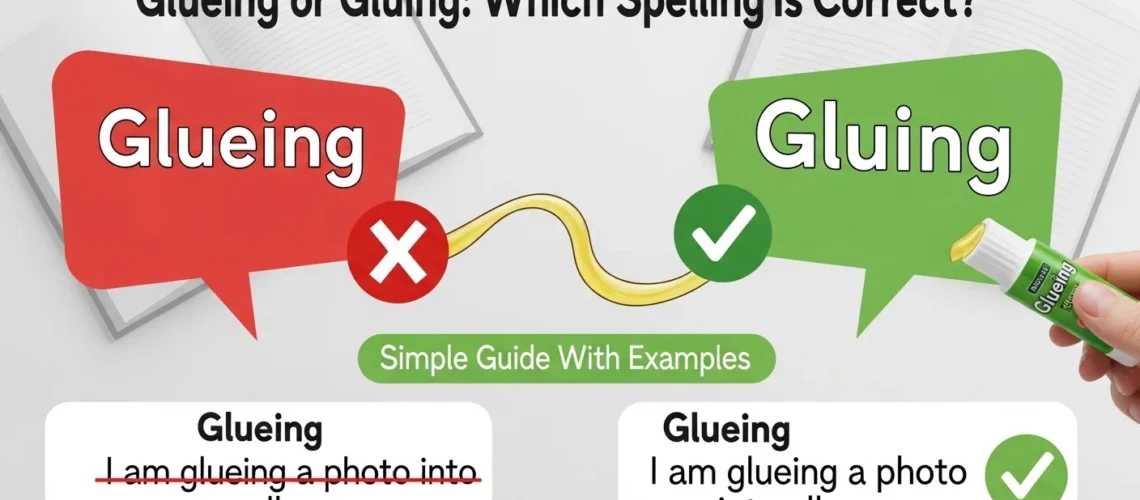
The correct spelling is gluing.
Glueing is incorrect in standard English.
Examples
- ✅ She is gluing the broken cup together.
- ❌ She is glueing the broken cup together.
Rule: When a verb ends in a silent e, drop the e before adding -ing.
- glue → gluing
- make → making
- bake → baking
The Origin of Glueing or Gluing
The word glue comes from Old French glu and Latin gluten, meaning “sticky substance.” For centuries, English has followed a spelling rule that drops the silent e before adding -ing.
This rule exists to keep spelling clean and pronunciation clear. Writing glueing adds an extra vowel that English does not need. Over time, dictionaries, publishers, and style guides standardized gluing as the only correct form.
Glueing appears today mainly because people apply logic instead of rules: “If the word is glue, why remove the e?” That thinking is natural—but English is not always logical.
British English vs American English Spelling
There is no difference between British and American English for this word.
Both varieties use gluing, not glueing.
Comparison Table
| Variant | Correct Spelling | Example |
| American English | gluing | He is gluing the model. |
| British English | gluing | She is gluing the papers. |
| Australian English | gluing | They are gluing tiles. |
| Canadian English | gluing | I am gluing wood pieces. |
✔ Same rule. Same spelling. Worldwide.
Which Spelling Should You Use?
Use gluing in all cases.
Audience-based advice:
- US audience: gluing
- UK audience: gluing
- Australia / Canada / NZ: gluing
- Global or SEO writing: gluing
There is no context where glueing is preferred in modern standard English.
Common Mistakes with Glueing or Gluing
Here are the most frequent errors:
- ❌ Writing glueing because the base word is glue
✔ Correct form: gluing - ❌ Assuming British English uses glueing
✔ British English also uses gluing - ❌ Ignoring spellcheck suggestions
✔ Spellcheck is right here—use gluing
Glueing or Gluing in Everyday Examples
Emails
- ✅ I am gluing the documents and will send them today.
News
- ✅ Workers are gluing panels to improve insulation.
Social Media
- ✅ Currently gluing this DIY project together 😂
Formal Writing
- ✅ The process involves gluing multiple layers securely.
Glueing or Gluing – Google Trends & Usage Data
Search data shows “gluing” is overwhelmingly more popular than “glueing” across all English-speaking countries. The rare searches for glueing usually come from spelling confusion, not correct usage.
- High usage: US, UK, Canada, Australia
- Context: DIY, crafts, construction, education, writing help
- SEO note: Search engines recognize gluing as correct and authoritative
Comparison Table: Keyword Variations
| Variation | Correct? | Notes |
| gluing | ✅ Yes | Standard and correct |
| glueing | ❌ No | Common spelling mistake |
| glued | ✅ Yes | Past tense |
| glues | ✅ Yes | Third person singular |
FAQs About Glueing or Gluing
1. Is “glueing” ever correct?
No. It is always considered incorrect in standard English.
2. Why does “glue” drop the e?
Because English drops silent e before adding -ing.
3. Do British dictionaries accept “glueing”?
No. They list gluing as the correct form.
4. Why does “gluing” look strange?
Because English spelling rules are not based on appearance, but structure.
5. Can I use “glueing” in informal writing?
You shouldn’t. Even informal writing follows standard spelling.
6. Is “gluing” used in academic writing?
Yes. It is the only accepted form.
7. Does spellcheck always flag “glueing”?
Most modern tools do, because it is incorrect.
Conclusion
The confusion around glueing or gluing is common, but the answer is simple. Gluing is the only correct spelling in modern English. The silent e in glue is dropped before adding -ing, following a standard and well-established rule. There is no difference between American, British, or other English varieties on this point.
If you remember just one thing, remember this: glue → gluing, never glueing. This applies to emails, academic writing, social media, news articles, and SEO content. Using the correct spelling improves clarity, credibility, and professionalism.
Writers often doubt themselves because gluing looks unusual at first glance. That feeling is normal. But dictionaries, style guides, and real-world usage all agree. Stick with gluing, and you’ll always be right.