Donut or Doughnut? Simple Guide to the Correct Spelling
February 16, 2026
Have you ever typed “donut or doughnut” into Google and wondered which spelling is correct? You are not alone. Millions of people search this phrase every year. Some see donut on shop boards and social media. Others read doughnut in books and newspapers. This difference often creates confusion, especially for students, writers, bloggers, and English learners.
Imagine writing an email, article, or exam answer and suddenly stopping: “Should I write donut or doughnut?” A small spelling mistake can reduce confidence and look unprofessional. That is why people want a clear and trusted answer.
This article solves that problem. You will learn the quick meaning, history, British vs American usage, common mistakes, real-life examples, and modern trends. Everything is explained in simple language. By the end, you will know exactly which spelling to use and when.
Donut or Doughnut – Quick Answer
Short Answer:
Both donut and doughnut are correct. They mean the same sweet, fried ring-shaped food.
Examples
- I bought a chocolate donut.
- She likes glazed doughnuts.
Key Point
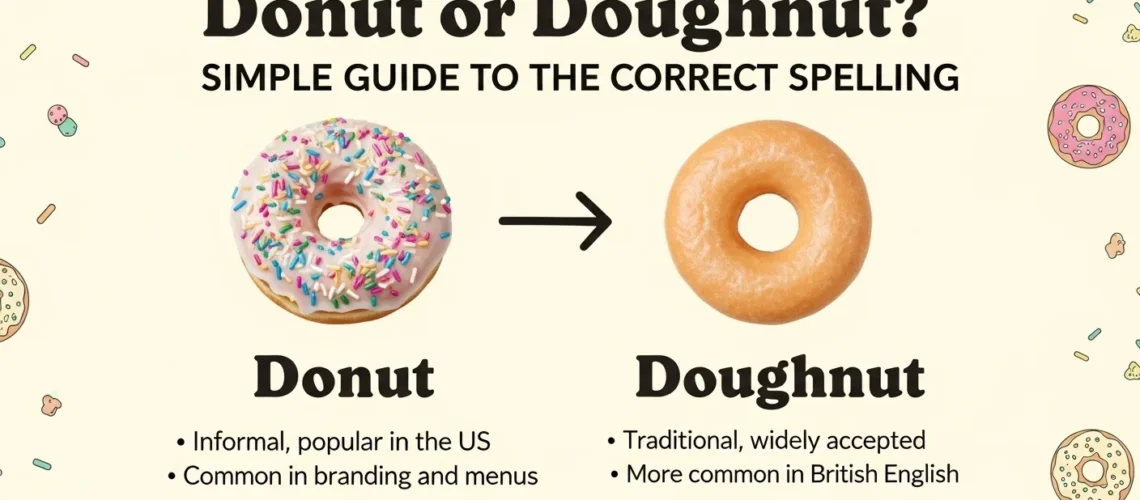
- Donut → Modern, informal, common in the USA
- Doughnut → Traditional, formal, used worldwide
Both are right. The choice depends on your audience.
The Origin of Donut or Doughnut
The word doughnut comes from two English words:
- Dough → soft mixture for baking
- Nut → small, round shape
In the 1800s, people called it dough-nut because it looked like a small nut made of dough.
How “Donut” Appeared
In the early 1900s, Americans started shortening words to make them easier. So:
- Doughnut → Donut
This shorter form became popular in ads, signs, and fast food shops.
Why Two Spellings Exist
- Doughnut = Original spelling
- Donut = Simplified American spelling
Both survived and are still used today.
British English vs American English Spelling
British and American English often use different spellings. This is also true for donut/doughnut.
Comparison Table
| Feature | British English | American English |
| Common Form | Doughnut | Donut |
| Formal Writing | Doughnut | Doughnut / Donut |
| Daily Use | Doughnut | Donut |
| Advertisements | Doughnut | Donut |
Examples
- UK: I had a jam doughnut.
- US: I had a glazed donut.
Summary
- UK prefers doughnut
- USA prefers donut
Which Spelling Should You Use?
Choose your spelling based on your audience.
For US Audience
Use donut
✔ Blogs, ads, social media, casual writing
For UK & Commonwealth
Use doughnut
✔ Exams, newspapers, formal writing
For Global Audience
Use doughnut
✔ Safer and more traditional
Quick Guide
| Audience Type | Best Choice |
| American | Donut |
| British | Doughnut |
| International | Doughnut |
| Casual Online | Donut |
| Academic | Doughnut |
Common Mistakes with Donut or Doughnut
Many learners make small errors with these words.
❌ Mistake 1: Mixing in One Text
Wrong: I like donut and doughnut both.
Correct: Use only one spelling.
❌ Mistake 2: Thinking One Is Wrong
Wrong: “Donut is incorrect.”
Correct: Both are correct.
❌ Mistake 3: Using Informal in Exams
Wrong (UK exam): I ate a donut.
Correct: I ate a doughnut.
❌ Mistake 4: Spelling Errors
Wrong: donout, dounut, dougnut
Correct: donut / doughnut
❌ Mistake 5: Ignoring Audience
Wrong: Using “donut” in formal UK writing
Correct: Use “doughnut”
Donut or Doughnut in Everyday Examples
Here is how both words appear in real life.
Emails
- Let’s meet for coffee and donuts tomorrow.
- I bought fresh doughnuts for the team.
News
- Local shop sells 1,000 doughnuts daily.
- New donut store opens downtown.
Social Media
- Love these pink donuts 😍
- Sunday = tea + doughnut ☕
Formal Writing
- The bakery specializes in traditional doughnuts.
- This report studies doughnut consumption.
Donut or Doughnut – Google Trends & Usage Data
Search data shows that donut is more popular in the United States, while doughnut is common in the UK and other countries.
According to data from Google, search trends reveal:
Popularity by Region
| Country/Region | Most Used |
| USA | Donut |
| UK | Doughnut |
| Canada | Doughnut |
| Australia | Doughnut |
| India | Doughnut |
Context Usage
- Marketing & Ads → Donut
- Education & News → Doughnut
- Social Media → Donut
- Books → Doughnut
Conclusion
“Donut” is modern and fast-growing. “Doughnut” remains strong in formal English.
Comparison Table: Donut vs Doughnut
| Feature | Donut | Doughnut |
| Length | Short | Long |
| Style | Informal | Formal |
| Origin | American | Traditional |
| Popularity | USA, Online | UK, Global |
| Academic Use | Rare | Common |
Frequently Asked Questions (FAQs)
Q1: Is “donut” wrong?
No. “Donut” is correct, mainly in American English.
Q2: Which spelling is older?
“Doughnut” is the original spelling.
Q3: Can I use both in one article?
No. Choose one and stay consistent.
Q4: Which is better for exams?
Use “doughnut,” especially in UK-based exams.
Q5: Why do shops prefer “donut”?
Because it is shorter and easier to remember.
Q6: Is “donut” slang?
No. It is an accepted modern spelling.
Q7: Which should bloggers use?
For US readers: donut. For global readers: doughnut.
Conclusion
The difference between donut and doughnut is simple once you understand it. Both words refer to the same delicious food. The main difference lies in style and region. Doughnut is the original, traditional spelling and is widely used in British and international English. It is best for exams, formal writing, and academic work. Donut is the modern, shortened form that is popular in the United States, advertising, and online content.
If your audience is American or casual readers, donut is a smart choice. If you are writing for UK readers, students, or professional platforms, doughnut is safer. The most important rule is consistency. Pick one spelling and use it throughout your text.
By following this guide, you can now write with confidence. No more confusion, no more hesitation—just clear and correct English.

Ross Raisin is a British author known for emotionally powerful novels, strong sense of place, rural themes, and deeply human storytelling.