CC’d or CC’ed – Which Is Correct in Emails and Writing?
February 1, 2026
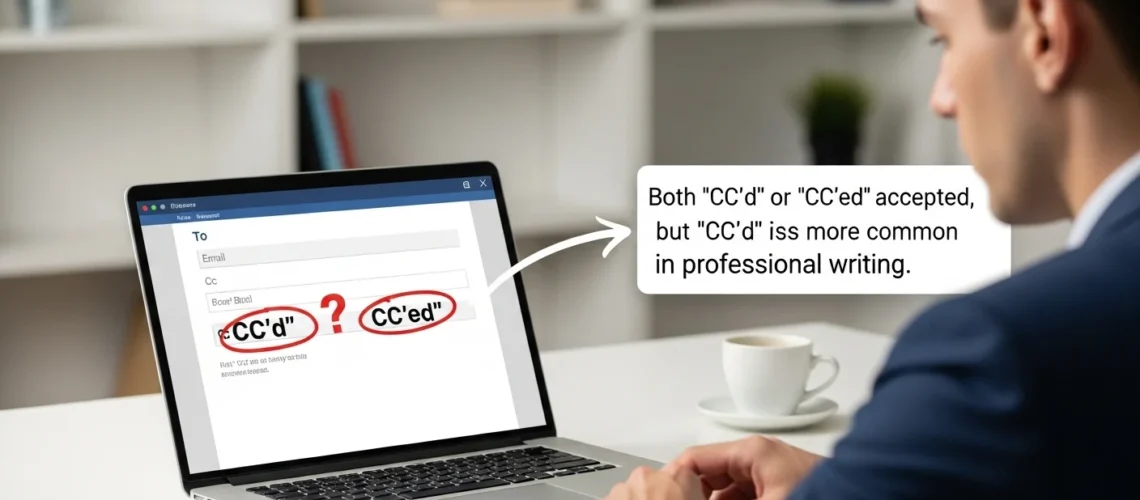
If you’ve ever paused while typing an email and wondered whether to write cc’d or cc’ed, you’re not alone. This tiny spelling choice causes outsized confusion for students, professionals, editors, and anyone who writes emails regularly. The problem usually appears at the worst moment—right before you hit Send on an important message. Is it “I cc’d John” or “I cc’ed John”? Both look odd. One feels shorter. The other feels safer.
People search for cc’d or cc’ed because the term comes from an abbreviation (CC, meaning carbon copy), not a normal verb. That makes standard past-tense spelling rules harder to apply. Different style guides, regions, and writing habits add to the confusion.
This article solves that problem clearly and quickly. You’ll get a direct answer, learn where the spellings come from, see how British and American English treat them, and know which one to use based on your audience. By the end, you’ll never hesitate over cc’d vs cc’ed again.
CC’d or CC’ed – Quick Answer
Both “cc’d” and “cc’ed” are correct.
They mean the same thing: someone was copied on an email.
Examples:
- I cc’d the manager on the email.
- She cc’ed the legal team for clarity.
That said, cc’d is more common in modern business writing and emails, especially in American English.
The Origin of CC’d or CC’ed
The term CC comes from carbon copy, a method once used to duplicate typed documents with carbon paper. Over time, email adopted CC to mean sending a copy of a message to another person.
Because CC is an abbreviation, writers had to decide how to turn it into a verb:
- Add ’d directly → cc’d
- Add -ed like a normal verb → cc’ed
Both forms developed naturally. Since abbreviations don’t follow strict spelling rules, style guides allow more than one option.
British English vs American English Spelling
American English tends to prefer shorter, simpler forms. British and Commonwealth English are often more flexible with -ed endings.
Comparison Table
| Variant | American English | British English | Notes |
| cc’d | Very common | Common | Preferred in emails |
| cc’ed | Less common | More accepted | Clearer for some readers |
| CC’d | Acceptable | Acceptable | Capitalized in formal writing |
Which Spelling Should You Use?
Choose based on your audience:
- US audience: Use cc’d
- UK / Commonwealth audience: cc’d or cc’ed both work
- Global or mixed audience: cc’d is safest and most common
- Formal or academic writing: Either, but stay consistent
Consistency matters more than the specific choice.
Common Mistakes with CC’d or CC’ed
Here are frequent errors and fixes:
- ❌ I cc John on the email yesterday
✅ I cc’d John on the email yesterday - ❌ I CCED the team
✅ I cc’ed the team or I cc’d the team - ❌ I was cc-ing everyone
✅ I was cc’ing everyone
CC’d or CC’ed in Everyday Examples
Emails
- I cc’d Sarah to keep her informed.
News
- The official cc’ed several departments in the announcement.
Social Media
- I cc’d support so they can respond faster.
Formal Writing
- The author cc’ed the committee on all correspondence.
CC’d or CC’ed – Google Trends & Usage Data
Search data shows that cc’d is more popular worldwide, especially in:
- United States
- Canada
- Australia
CC’ed appears more often in:
- UK-based writing
- Formal or edited documents
Overall, cc’d dominates in everyday email communication.
Comparison Table: Keyword Variations
| Form | Correct | Common Use |
| cc’d | ✅ Yes | Most common |
| cc’ed | ✅ Yes | Less common |
| cced | ❌ No | Incorrect |
| cc’ded | ❌ No | Incorrect |
FAQs About CC’d or CC’ed
1. Is “cc’d” grammatically correct?
Yes. It is widely accepted in modern English.
2. Is “cc’ed” more formal than “cc’d”?
Not really. It just looks more traditional to some readers.
3. Should CC be capitalized?
Capitalization is optional. Lowercase is common in emails.
4. Can I use “copied” instead?
Yes. Copied avoids the issue completely.
5. What do style guides recommend?
Most allow both, as long as you are consistent.
6. Is “bcc’d” spelled the same way?
Yes. bcc’d and bcc’ed follow the same rules.
7. Which is better for SEO writing?
Use cc’d, but mention cc’ed for clarity.
Conclusion
The debate over cc’d or cc’ed may seem small, but it reflects a real challenge in modern writing: turning abbreviations into verbs. The good news is simple—both forms are correct. You don’t need to stress or second-guess yourself.
If you want the safest choice, especially in emails and business writing, cc’d is the clear winner. It’s shorter, more common, and widely understood. CC’ed is not wrong, but it appears less often and may feel dated to some readers.
The key rule is consistency. Pick one spelling and use it the same way throughout your writing. If you ever feel unsure, using “copied” is always a clean alternative.
Now that you understand the origin, usage, and audience preferences, you can write with confidence—and hit Send without hesitation.

Ross Raisin is a British author known for emotionally powerful novels, strong sense of place, rural themes, and deeply human storytelling.