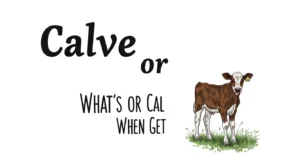
Calve or Calf – What’s the Correct Word and When to Use It?
February 2, 2026

English learners and even native speakers often pause when choosing between calve or calf. At first glance, they look like simple spelling variants, but they are not interchangeable. This confusion usually appears when writing about animals, farming, anatomy, fitness, or biology. People search for “calve or calf” because both words are closely related, sound similar, and appear in the same contexts—especially when talking about cows giving birth or the lower part of the human leg.
The problem is that calf is a noun, while calve is a verb. Mixing them up can change the meaning of a sentence or make it grammatically incorrect. For example, “The cow will calf” is wrong, but many writers still use it. Similarly, saying “I injured my calve” is a common spelling mistake.
This guide solves that confusion clearly and quickly. You’ll learn the exact difference, where each word comes from, how British and American English treat them, and which one you should use based on your audience. By the end, you’ll confidently choose the right word every time.
Calve or Calf – Quick Answer
Calf is a noun.
Calve is a verb.
Examples:
- ✅ The cow gave birth to a healthy calf.
- ✅ The cow will calve in spring.
- ❌ The cow will calf. (incorrect)
- ❌ I hurt my calve. (incorrect)
Simple rule:
- If it’s a thing or body part, use calf.
- If it’s an action (giving birth), use calve.
The Origin of Calve or Calf
The word calf comes from Old English cealf, meaning a young cow or bull. Over time, it was also used to describe the back of the lower leg, likely because of its rounded shape.
Calve developed from the same root but evolved into a verb meaning “to give birth to a calf.” It also gained other meanings, such as ice breaking off a glacier.
The spelling difference exists because English often uses noun–verb pairs with slight spelling changes to show different grammatical roles.
British English vs American English Spelling
There is no spelling difference between British and American English for calf or calve. The rules are the same in both.
Comparison Table
| Aspect | Calf | Calve |
| Part of speech | Noun | Verb |
| Meaning | Young cow / lower leg | To give birth |
| UK English | Calf | Calve |
| US English | Calf | Calve |
| Common error | Used as verb | Used as noun |
Which Spelling Should You Use?
Choose based on function, not location.
- US audience: Follow standard grammar (calf = noun, calve = verb)
- UK/Commonwealth audience: Same rules apply
- Global audience: Use calf for objects or anatomy, calve for actions
If you can replace the word with “give birth”, use calve. Otherwise, use calf.
Common Mistakes with Calve or Calf
Frequent Errors:
- ❌ The cow will calf next week.
✅ The cow will calve next week. - ❌ He pulled his calve muscle.
✅ He pulled his calf muscle. - ❌ Three calves were born when the cow calved.
✅ Three calves were born when the cow calved.
Calve or Calf in Everyday Examples
Emails
- The vet said the cow may calve tonight.
News
- Farmers reported strong calf survival this season.
Social Media
- Leg day hurts—my calves are on fire!
Formal Writing
- The glacier began to calve, releasing large ice blocks into the sea.
Calve or Calf – Google Trends & Usage Data
Search data shows:
- “Calf” is more popular worldwide due to fitness, anatomy, and food topics.
- “Calve” is searched mainly in farming, veterinary, and climate contexts.
- English-speaking countries use both correctly, but errors spike in informal writing.
Trend insight: Most users search this keyword to confirm grammar accuracy, not spelling variants.
Calve vs Calf – Side-by-Side Comparison
| Feature | Calf | Calve |
| Grammar role | Noun | Verb |
| Plural form | Calves | Calves (verb form) |
| Refers to | Animal, leg, meat | Birth process |
| Example | A baby calf | Cows calve in spring |
FAQs About Calve or Calf
1. Is “calf” ever a verb?
No. Calf is always a noun.
2. What is the plural of calf?
The plural is calves.
3. Can glaciers calve?
Yes. Calve also means ice breaking off a glacier.
4. Is “calve muscle” correct?
No. The correct term is calf muscle.
5. Do British and American English use different spellings?
No. Both use calf and calve the same way.
6. Which word is more common?
Calf is more common in everyday English.
7. How can I remember the difference?
Think: calf = thing, calve = action.
Conclusion
The difference between calve or calf is simple once you know the rule, yet it causes frequent mistakes in writing and speech. Calf is a noun that refers to a young cow, the lower leg, or related meanings. Calve is a verb that describes the act of giving birth—or ice breaking away from a glacier. They are related in meaning but serve very different grammatical roles.
There is no British or American spelling difference, so the correct choice depends entirely on how the word functions in your sentence. If you are naming something, choose calf. If you are describing an action, choose calve. Paying attention to this distinction will instantly improve clarity and professionalism in your writing.
Whether you’re writing an email, an article, or a social media post, using the correct form builds trust and avoids confusion. Remember: you can have a calf, but you calve.

Thomas Hardy was a classic English novelist and poet, famous for tragic rural stories, deep social themes, and timeless works like Tess of the d’Urbervilles and Jude Law.