Burnt or Burned: Which One Is Correct? Simple Guide with Examples
January 30, 2026
Have you ever paused mid-sentence wondering whether to write burnt or burned? You’re not alone. This is one of the most searched spelling questions in English because both forms are correct, yet they are used differently depending on region, tone, and context. Writers, students, bloggers, and even native speakers often hesitate before choosing one. A small spelling choice can feel risky—especially in formal writing, exams, or professional emails.
The confusion exists because English has two major standards: British English and American English. Each treats past tense forms a little differently. Add informal speech, headlines, and modern trends, and the rules feel blurry. Is burnt toast wrong in the US? Is burned down incorrect in the UK? Not exactly.
This article solves that confusion fast. You’ll get a clear answer, learn the history behind the spellings, see real-life examples, and know which word to use for your audience. By the end, you’ll choose between burnt or burned with confidence—every time.
Burnt or Burned – Quick Answer
Both burnt and burned are correct.
The difference depends on region and usage.
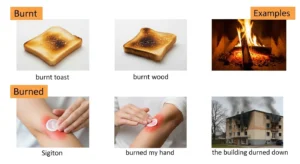
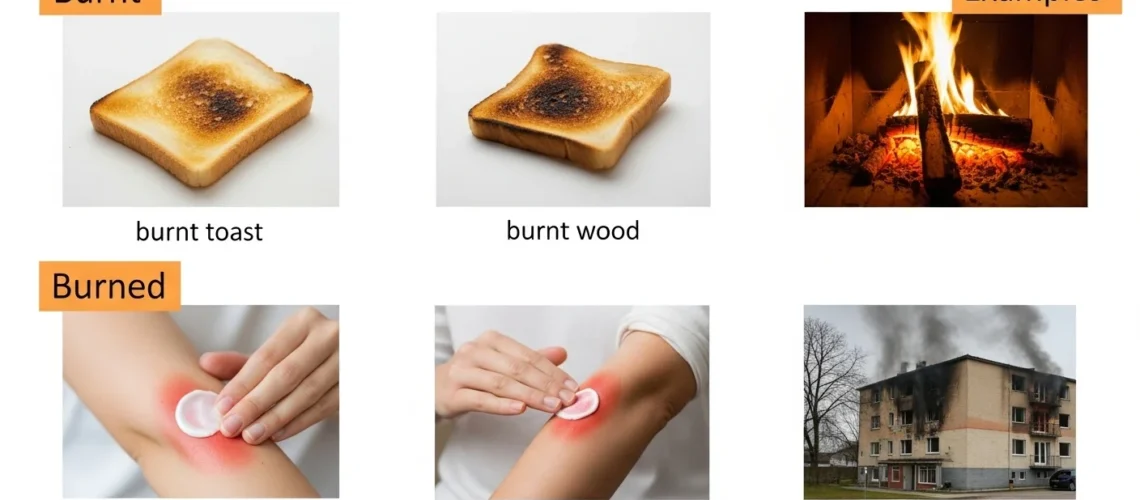
- Burned → Preferred in American English for the past tense and past participle.
Example: The house burned down last night. - Burnt → Common in British English, often used as an adjective.
Example: I smelled burnt toast.
Simple rule:
- Verb action → burned (especially in the US)
- Description/adjective → burnt (especially in the UK)
The Origin of Burnt or Burned
The verb burn comes from Old English beornan (to burn) and bærnan (to set on fire). In early English, verbs often had two past forms. Over time, English simplified many verbs by adding -ed, especially in American usage.
British English kept more irregular forms, such as:
- dreamt
- learnt
- spoilt
- burnt
American English standardized spellings for clarity and consistency, favoring:
- dreamed
- learned
- spoiled
- burned
That’s why both forms survived. They come from the same root, but evolved differently across regions.
British English vs American English Spelling
Key Differences
| Feature | British English | American English |
| Preferred past tense | burnt | burned |
| Common adjective form | burnt toast | burned toast (less common) |
| Formal writing | burnt often accepted | burned strongly preferred |
| News & reports | mixed usage | burned almost always |
Examples
- UK: He burnt his hand on the stove.
- US: He burned his hand on the stove.
Both are grammatically correct, but regional preference matters.
Which Spelling Should You Use?
Choose based on your audience:
- United States audience → Use burned
Best for blogs, emails, academic work, and SEO content. - UK, Australia, Canada (mixed), Commonwealth → Burnt is fine, especially in informal writing.
- Global or international audience → Use burned
It’s more widely recognized and safer for professional use.
Tip: If unsure, choose burned. It is never considered wrong.
Common Mistakes with Burnt or Burned
Here are frequent errors and fixes:
- ❌ The building was burn’t down.
✅ The building was burned down. - ❌ I have burnt the CD yesterday.
✅ I burned the CD yesterday. - ❌ Mixing forms in one sentence
✅ Stay consistent in tone and region. - ❌ Using burnt in very formal US writing
✅ Prefer burned for clarity.
Burnt or Burned in Everyday Examples
Emails
- Sorry, I burned the document by mistake.
News
- Three homes burned during the fire.
Social Media
- Oops, my pizza is burnt 😅
Formal Writing
- The files were burned to a secure disk.
Burnt or Burned – Google Trends & Usage Data
Search trends show:
- Burned dominates searches in the US.
- Burnt is more common in the UK, Australia, and New Zealand.
- Globally, burned appears more often in:
- News articles
- Technical writing
- Academic content
- News articles
This confirms that burned is the safer choice for worldwide audiences.
Burnt vs Burned – Comparison Table
| Form | Type | Common Regions | Example |
| Burned | Verb (past) | US, global | The paper burned quickly. |
| Burnt | Adjective | UK, informal | The toast is burnt. |
| Burned | Past participle | US | The CD was burned. |
| Burnt | Past tense (UK) | UK | He burnt the letter. |
FAQs About Burnt or Burned
1. Are burnt and burned both correct?
Yes. Both are correct English spellings.
2. Is burnt wrong in American English?
No, but it sounds informal or descriptive.
3. Can I use burnt as a verb?
Yes, mainly in British English.
4. Which is better for SEO writing?
Burned works better for global and US audiences.
5. Is burnt only an adjective?
No, but it is most commonly used that way.
6. What do style guides recommend?
Most US style guides prefer burned.
7. Can I mix burnt and burned in one article?
Avoid mixing. Stay consistent.
Conclusion
The choice between burnt or burned is not about right or wrong—it’s about context, region, and audience. Both spellings come from the same origin, and both are accepted in modern English. However, usage patterns matter. Burned dominates American English and global professional writing, making it the safest option for blogs, emails, academic work, and SEO content. Burnt, on the other hand, feels natural in British English and works well as an adjective in informal speech.
If you’re writing for an international audience or want to avoid confusion, choose burned. If your audience is mainly British or Commonwealth readers, burnt is perfectly fine. The key is consistency. Pick one form and stick with it throughout your writing.
Now that you understand the difference, you’ll never hesitate again when choosing between burnt or burned.

Thomas Hardy was a classic English novelist and poet, famous for tragic rural stories, deep social themes, and timeless works like Tess of the d’Urbervilles and Jude Law.